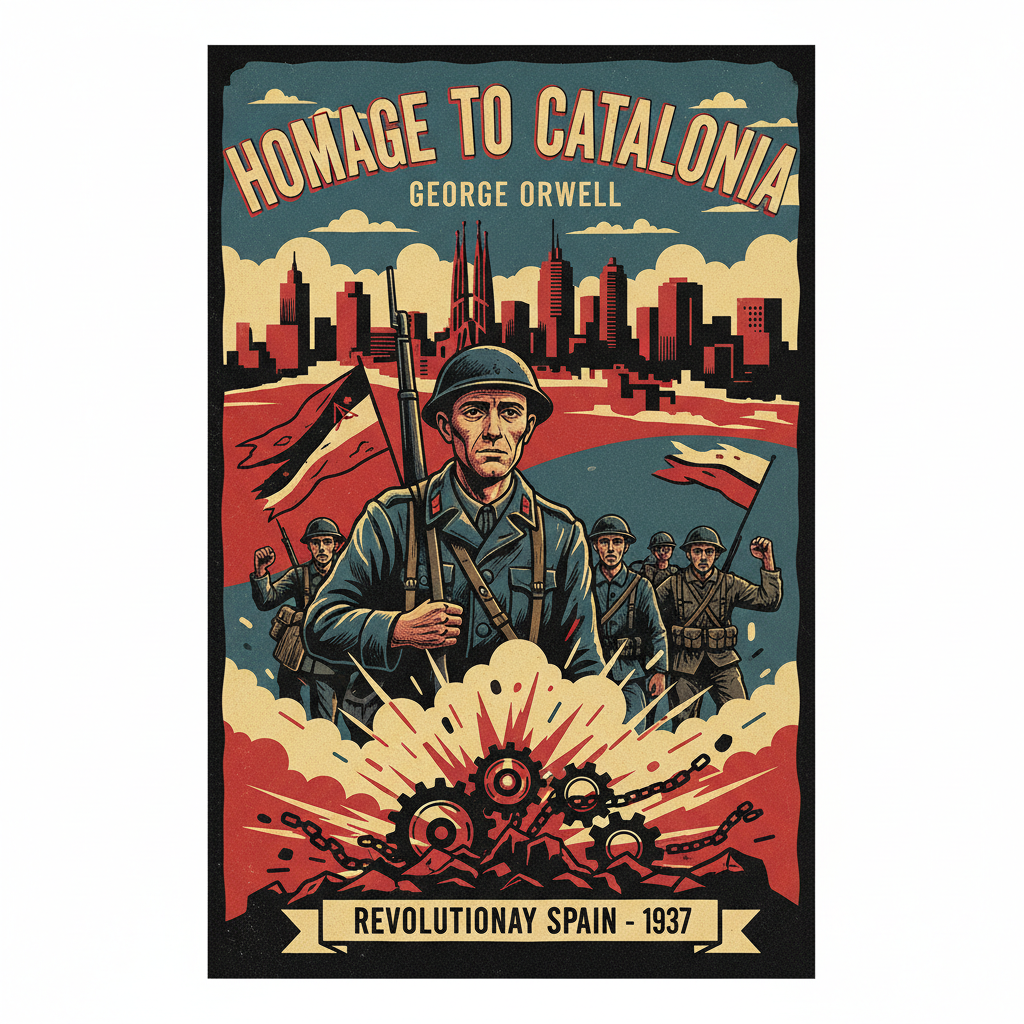
A First-Hand Account of the Spanish Civil War
George Orwell's Homage to Catalonia stands as a unique and essential text, transcending the boundaries of traditional memoir and political commentary. Published in 1938, it is a raw, firsthand account of the author's experience as a volunteer soldier in the Spanish Civil War. While many foreign journalists and writers romanticized the conflict from a distance, Orwell’s narrative is a descent from political idealism into a grim reality of factionalism, betrayal, and the brutal absurdity of modern warfare. Through his lucid prose and unsparing honesty, Orwell captures not only the physical hardships of the front lines but also the profound political and psychological disillusionment that would shape his most famous allegories of totalitarianism.
Orwell arrived in Spain in late 1936, motivated by a sincere belief in the Republican cause and a desire to combat fascism. He joined the POUM (Workers' Party of Marxist Unification), a left-wing anti-Stalinist group, expecting a unified, revolutionary struggle. His initial descriptions reflect a sense of camaraderie and equality, portraying an army where social hierarchies had been dissolved. However, this revolutionary fervor was short-lived. As he details his return to Barcelona from the front, a stark transformation is evident. The initial revolutionary spirit had been replaced by a tense, politically charged atmosphere where the city was rife with suspicion and armed conflict between the various leftist factions. This internal war, particularly the violent suppression of the POUM by the Soviet-backed Communists, shattered his belief in a unified front and exposed a deeper ideological war far more insidious than the one against fascism.
Beyond the political treachery, Homage to Catalonia provides a starkly unromanticized depiction of war itself. Orwell describes the day-to-day reality of life in the trenches with a journalist's eye for detail, focusing on the pervasive mud, hunger, fleas, and cold. He highlights the sheer boredom and inactivity that defined much of the soldier's existence, punctuated by random and terrifying moments of shelling or gunfire. This is a significant departure from heroic narratives; Orwell’s account strips away the glory, revealing the mundane suffering and senselessness of combat. His own wounding, a seemingly insignificant neck injury that nearly killed him, underscores the arbitrary nature of life and death on the battlefield. By focusing on these granular, unheroic details, Orwell delivers a more powerful condemnation of war than any grand political statement could.
The disillusionment chronicled in Homage to Catalonia was not just a personal experience for Orwell; it was a foundational moment in his intellectual evolution. The political purges and propaganda he witnessed in Barcelona served as a grim foreshadowing of the totalitarian regimes he would later scrutinize. The Communist Party's systematic lying and manipulation of history, where the POUM was falsely accused of being a fascist organization, laid the groundwork for the concepts of "doublethink" and the rewriting of history in Nineteen Eighty-Four. The book, therefore, serves as a crucial bridge between Orwell's earlier political idealism and the pessimistic, dystopian visions of his later work. It is in the trenches of Spain that Orwell learned firsthand the dangers of unchecked power, political orthodoxy, and the suppression of truth, lessons that would inform his most enduring literary contributions.
In conclusion, Homage to Catalonia is more than a historical memoir; it is a testament to the fragile nature of political ideals in the face of brutal reality. George Orwell's journey from an enthusiastic volunteer to a disillusioned fugitive provides a cautionary tale about the complexities of ideological conflict. The book's enduring power lies in its unwavering honesty and its ability to expose the harsh truths of war and political betrayal. It remains a vital document for understanding the Spanish Civil War and a compelling account of the experiences that transformed one of the 20th century’s most important political thinkers.